The redevelopment train is coming to Savannah’s Railroad District. Let’s discuss
The Signal
Savannah is quietly assembling one of its most consequential urban redevelopment plays in years — five city-owned properties around the historic Railroad District are now on the table for housing, food halls, creative office, and a restored roundhouse, and the consultants are already in the room.
Why It Matters
The Railroad District sits at the western edge of Savannah’s historic core, adjacent to the MLK corridor and Tricentennial Park — an area that has long been underutilized relative to its cultural significance. The City’s decision to formally brand this area and engage a national real estate consultant signals that this is no longer just a preservation conversation. It is a development conversation.
For commercial real estate, the implications are layered. A micro food hall in the historic train shed would create a new food-and-beverage destination west of downtown, drawing foot traffic to a corridor that currently lacks daily-needs activation. The proposed creative office use in the paint shop would add boutique office inventory in a market where authentic, character-rich space is genuinely scarce. Affordable and market-rate housing on the corner parcel would add residential density to a neighborhood that is already being reshaped by the adjacent Civic Center redevelopment. Taken together, this is not one project — it is a district-scale transformation.
The timing matters, too. This planning effort is running in parallel with the MLK Civic Center redevelopment (230–300 housing units, up to 45,000 sq ft of commercial space) and the Canal District study. The west side of Savannah’s historic core is being reimagined simultaneously on multiple fronts. Investors and tenants who understand this convergence will be positioned ahead of the market.
What Happened
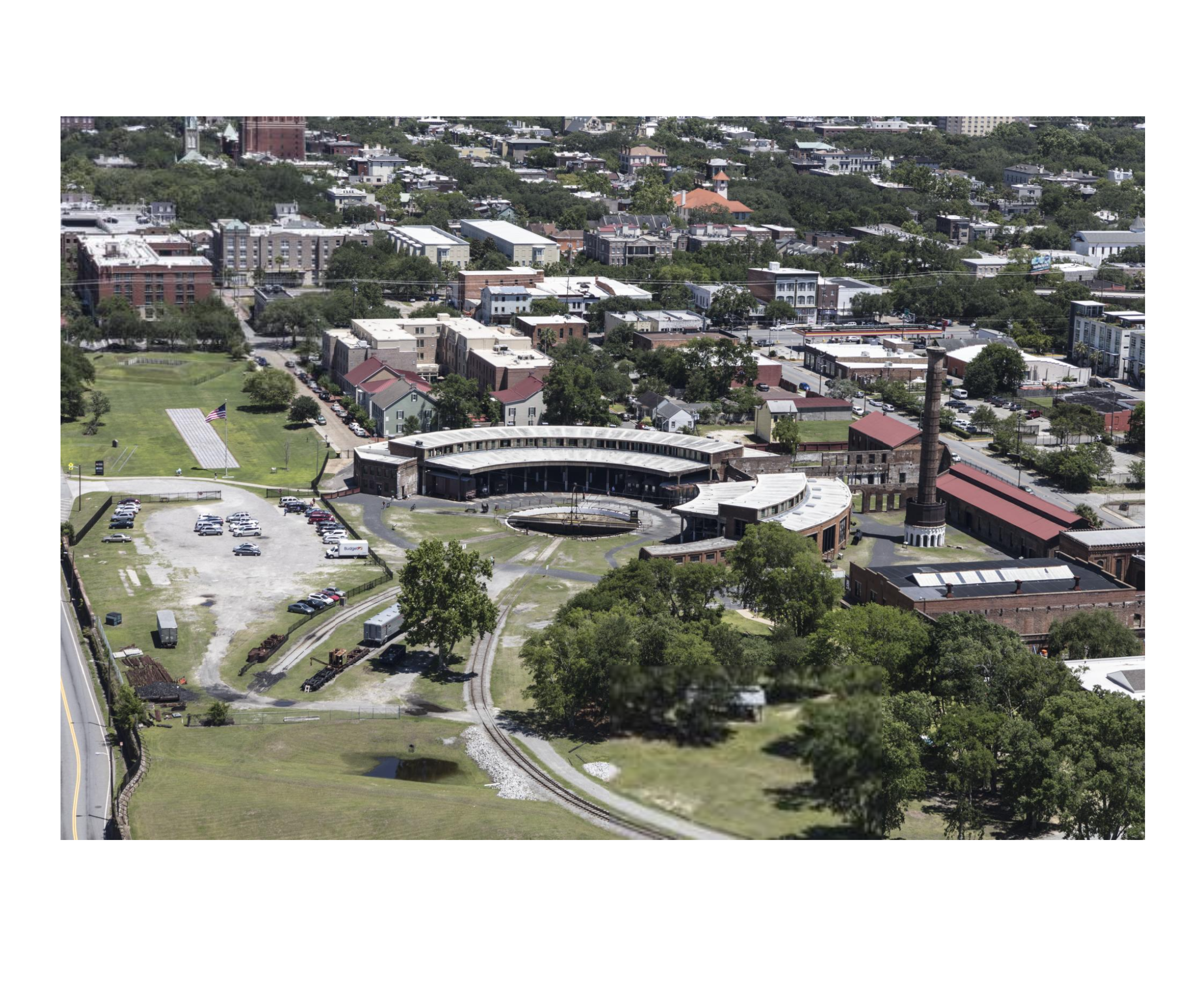
The City of Savannah has identified five city-owned properties in and around the Coastal Heritage Society’s museum campus — an area it has now officially dubbed the “Railroad District” — as candidates for new development. The city solicited public input at a recent open house, using a dots-on-boards format to gauge community priorities. Consultants RCLCO and EDSA presented a menu of potential uses for each site, ranging from a restored historic roundhouse to market-rate apartments to a micro food hall inside the 19th-century train shed.
The Coastal Heritage Society, which operates the Georgia Railroad Museum (a National Historic Landmark), the Savannah History Museum, the Savannah Children’s Museum, and Battlefield Memorial Park on the city-leased Tricentennial Park site, is a key partner. CHS CEO Nora Fleming Lee has stated that the organization hopes limited development will generate revenue to fund historic preservation and expand its children’s museum programming.
RCLCO Managing Partner Jake Ross was clear at the open house: “When we talk about development in this area, we’re not talking about replacing any entities. We’re talking about building on them so that there’s more things for people to do when they come before or after, more places for people to live nearby, or to just interact with the site.” 1
Community input showed strong support for museum uses at the paint shop and roundhouse, and notable support for affordable rental housing at the corner parcel near Louisville Road.
Who’s Involved
| Role | Entity |
| Property Owner | City of Savannah |
| Cultural Operator / Partner | Coastal Heritage Society (CEO: Nora Fleming Lee) |
| Real Estate Consultant | RCLCO (Jake Ross, Managing Partner) |
| Design Consultant | EDSA (Kona Gray, Principal) |
| Anchor Institution | Georgia Railroad Museum (National Historic Landmark) |
The Five Sites at a Glance
| Site | Location | Proposed Uses |
| North Parking Lot | Visitor Center, Tricentennial Park | Market-rate apartments, hospitality, ground-floor retail |
| Historic Train Shed & Headhouse | Visitor Center / History Museum | Micro food hall, café/restaurant |
| Paint Shop | W. Boundary St. & W. Jones St. | Museum, creative office, event venue, F&B |
| Corner Parcel | W. Boundary St. & Louisville Rd. | Affordable housing, hospitality, market-rate housing |
| Restored Roundhouse | Georgia Railroad Museum campus | Museum, small-scale retail/F&B, event venue |
Timeline
| Date | Event |
| Early 2026 | City formally brands area as “Railroad District”; engages RCLCO and EDSA |
| Feb. 18, 2026 | Community meeting on Railroad District and Civic Center studies held |
| March 1, 2026 | Savannah Morning News reports on development plans; open house feedback revealed |
| Coming Months | Final report with definitive project recommendations expected |
| TBD | City to determine implementation pathway (developer RFP, phasing, etc.) |
What to Watch Next
The most important trigger to watch is the release of the final consultant report, which will move this from a community input exercise to an actionable development framework. Once that report is published, the city will need to decide how to implement — whether through a competitive developer RFP, a public-private partnership structure, or phased city-led investment. Watch also for how this planning connects to the adjacent MLK Civic Center redevelopment, where a separate RCLCO-led process is already further along. If the city aligns these two planning efforts into a unified west-side strategy, the combined impact on the MLK corridor and Tricentennial Park area will be significant.
The west side of Savannah’s historic core is being redrawn. If you own, lease, or are considering a play in this corridor — you need to be in the conversation now.
•Own commercial or residential property near the MLK corridor, Tricentennial Park, or the west historic district? Your value trajectory just changed.
•Considering a retail, office, or hospitality opportunity in downtown Savannah? This district is worth a serious look before the final plan drops.
That’s the signal.
— Ryan
Contact Ryan Schneider, CCIM | PIER Commercial Real Estate
ryan@piercommercial.com | 912-239-6298 | www.piercommercial.com